For the last three years, Artificial Intelligence (AI) has dominated headlines, boardrooms and investment conferences across the world.
Technology leaders promised a future where software would write software, machines would replace routine office work, and companies would dramatically reduce their dependence on human labour. Investors responded enthusiastically. Governments announced ambitious AI missions. Corporations committed billions of dollars to AI infrastructure. Massive data centres began appearing across the globe.
For a while, it seemed as though humanity was on the verge of an economic revolution comparable to the arrival of electricity, the internet or the smartphone.
Yet as we move through 2026, the conversation is changing.
AI continues to advance at an extraordinary pace. Its capabilities are undeniable. But alongside the excitement, a more mature discussion has begun to emerge. Business leaders, policymakers and even the architects of AI themselves are increasingly asking tougher questions.
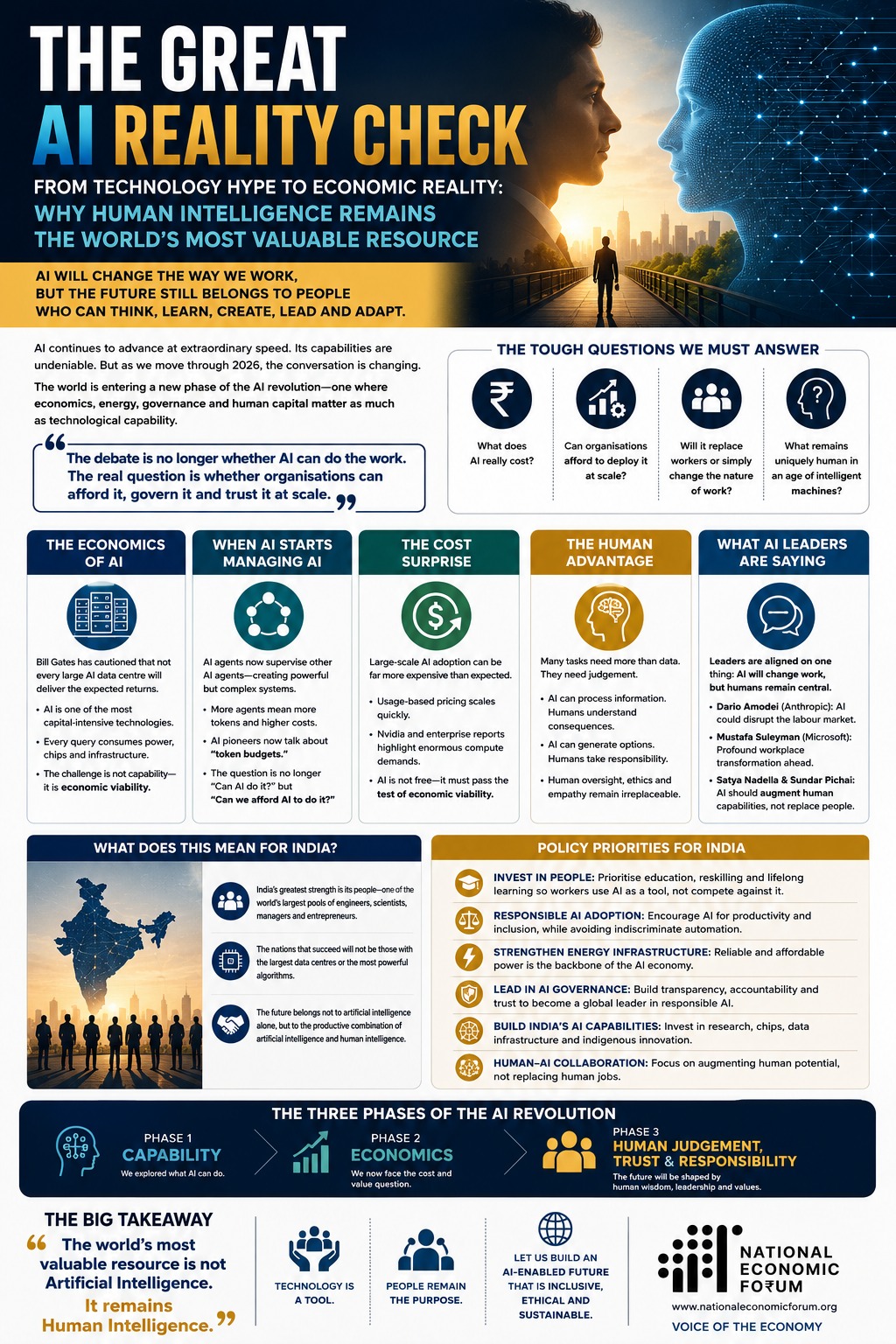
What does AI really cost? Can organisations afford to deploy it at scale? Will it replace workers or simply change the nature of work? And perhaps most importantly, what remains uniquely human in an age of intelligent machines?
The world is entering a new phase of the AI revolution—one where economics, energy, governance and human capital matter as much as technological capability.
The Economics of AI: The Question Nobody Asked
The early AI narrative was simple. Machines would perform work previously done by humans. Productivity would soar. Costs would fall.
Reality, however, is proving more complicated.
The early AI narrative was simple. Machines would perform work previously done by humans. Productivity would soar. Costs would fall. Reality, however, is proving more complicated.
Recently, Bill Gates observed that not every large AI data centre currently being built will necessarily generate the returns that investors expect. His comments reflect a growing concern across the technology industry.
Unlike traditional software, AI consumes enormous computing power. Every query, every report, every image and every automated task requires servers, specialised chips, cooling systems and electricity. These costs do not disappear after deployment. They continue every day, every hour and with every interaction.
The result is that AI has become one of the most capital-intensive technologies ever developed.
At the same time, advances in hardware are occurring so rapidly that companies face the risk of investing billions in infrastructure that may become less competitive long before its economic life is complete. The challenge today is no longer whether AI can perform a task. The challenge is whether it can perform that task economically.
At the same time, advances in hardware are occurring so rapidly that companies face the risk of investing billions in infrastructure that may become less competitive long before its economic life is complete.
The challenge today is no longer whether AI can perform a task. The challenge is whether it can perform that task economically.
When AI Starts Managing AI
Another significant shift is occurring within the AI industry itself. The first generation of AI systems required humans to write prompts and guide every interaction. Increasingly, however, leading AI developers are discussing a future where AI agents supervise other AI agents.
Boris Cherny of Anthropic recently described how AI systems are beginning to generate prompts for other AI systems. Google Cloud executive Addy Osmani has spoken about workflows involving multiple agents, plugins, connectors and specialised sub-agents working together to complete tasks.
At first glance, this appears to be a remarkable advance. Yet it also reveals an important reality. Every additional agent consumes computing resources. Every sub-agent generates more token usage. Every layer of automation increases operational costs.
Significantly, some of the same AI pioneers promoting agent-based systems are now discussing "token budgets" and warning organisations against deploying unnecessary AI agents.
The discussion is increasingly shifting from intelligence to economics. Not "Can AI do it?" But "Can we afford AI to do it?"
The Cost Surprise
Many organisations are now discovering that large-scale AI adoption can be more expensive than expected.
Unlike employees, whose costs are relatively predictable, AI systems operate on usage-based pricing. Every interaction generates a cost. As usage expands across thousands of workers and millions of transactions, those costs can rise rapidly.
Unlike employees, whose costs are relatively predictable, AI systems operate on usage-based pricing. Every interaction generates a cost. As usage expands across thousands of workers and millions of transactions, those costs can rise rapidly.
This does not mean AI is ineffective. It means AI is not free. Like every technology before it, AI must eventually pass the test of economic viability.
Moreover, AI's growing appetite for electricity is creating a new strategic challenge. Nations that possess reliable energy infrastructure, semiconductor capabilities and advanced computing resources may enjoy significant advantages in the coming decade. Increasingly, AI is becoming as much an energy and infrastructure story as a software story.
The Human Advantage
Even more interesting is the discovery that many tasks require more than information processing. They require judgement. AI can generate a legal draft. A lawyer must decide whether it is appropriate. AI can analyse medical records. A doctor must decide the course of treatment. AI can evaluate financial data. A manager must decide how to act on that information.
AI can identify patterns. Humans understand consequences. AI can process information. Humans assume responsibility. This distinction is becoming increasingly important.
Businesses are discovering that while AI can automate certain tasks, it often struggles with ambiguity, context, ethics, emotional intelligence and real-world complexity.
The result is that human oversight remains indispensable.
What AI Leaders Are Actually Saying
Interestingly, the most balanced perspectives on AI are now coming from the people building it.
Anthropic CEO Dario Amodei has warned that AI could significantly disrupt parts of the labour market. Microsoft AI Chief Mustafa Suleyman has spoken about profound workplace transformation. At the same time, Microsoft CEO Satya Nadella and Google CEO Sundar Pichai continue to emphasise that AI should augment human capabilities rather than simply replace people.
The message emerging from these leaders is nuanced.
AI will undoubtedly change work. Some jobs will disappear. Many jobs will evolve.New professions will emerge. But there is little evidence that successful organisations will operate without human talent.
In fact, the opposite may prove true. The more advanced AI becomes, the greater the value of human judgement, leadership, creativity and accountability.
What Does This Mean for India?
For India, this moment presents both a challenge and an opportunity.
India should neither fear AI nor worship it. The country's greatest strength has never been technology alone. Its greatest strength is its people.
India possesses one of the world's largest pools of engineers, scientists, managers, entrepreneurs and skilled professionals. In the AI era, this human capital may become even more valuable.
The countries that succeed will not necessarily be those with the largest data centres or the most powerful algorithms. They will be those with the largest number of people capable of working effectively with AI. The future belongs not to artificial intelligence alone, but to the productive combination of artificial intelligence and human intelligence.
Policy Priorities for India
India's AI strategy should place human capital at its centre.
The first priority must be investment in education, reskilling and lifelong learning. Workers should be equipped to use AI as a tool rather than compete against it.
Second, policymakers should encourage responsible AI adoption while avoiding indiscriminate automation that generates social disruption without corresponding productivity gains.
Third, India must significantly strengthen its energy infrastructure. AI is ultimately an energy-intensive technology, and reliable, affordable power will become a strategic economic asset.
Fourth, India should position itself as a leader in AI governance, transparency and accountability. Trust will become a major source of competitive advantage.
Fifth, India should encourage domestic innovation in AI, semiconductors, data infrastructure and applied research so that it becomes not merely a consumer of AI technologies but also a creator of them.
Finally, businesses should focus on human-AI collaboration rather than labour replacement. The objective should be to make people more productive, not merely fewer in number.
The first phase of the AI revolution was about capability. The second phase is about economics. The third phase will be about human judgement, trust and responsibility.
Artificial Intelligence will undoubtedly transform industries, create new opportunities and reshape many professions. But the excitement surrounding AI should not distract us from a fundamental truth.
Every major technological revolution in history—from the steam engine to electricity, from computers to the internet—ultimately created value not because of the technology itself, but because people found new ways to use it. AI will be no different.
The nations that prosper will not necessarily be those with the largest data centres or the most powerful algorithms. They will be those that successfully combine technological capability with educated citizens, skilled workers, ethical institutions and visionary leadership.
Technology has always been a tool. People remain the purpose.
As governments, businesses and societies navigate the AI age, they would do well to remember one simple fact:
The world's most valuable resource is not Artificial Intelligence. It remains Human Intelligence.
Jagdip Rana
Executive Director – Policy & Strategy National Economic Forum (NEF)